

Notus – Gas Raman Spectrometer
A Revolution In Gas Analysis
Raman spectroscopy is a well-established technique that demonstrates excellent chemical sensitivity for identifying a diverse range of solid and liquid samples. However, due to the diffuse nature of gases, their inherently weak optical scattering makes analysis challenging.
A practical method to overcome this limitation is to extend the optical path length to optimise the interaction of excitation photons with Raman scattering centres. This increases the generation of unique energy-shifted Raman photons, which deliver the unique chemical fingerprint of the target gas or gases.

Product Specifications
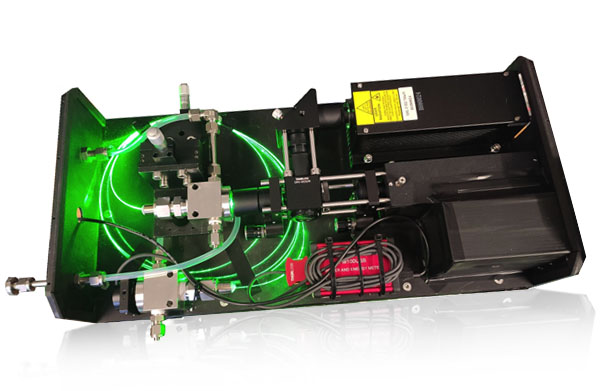
Gas Raman
Notus, ISI’s gas Raman instrument, uses hollow-core microstructured fibre optics, in which the target gas species is drawn into the internal volume of the hollow-core fibre.
The gas’s Raman spectra are captured via a hardware configuration comprising a laser, dispersive spectrometer, and coupling optics. The instrument delivers in situ gas measurements quickly and offers other significant benefits over traditional gas chromatography or Fourier Transform Infrared (FTIR) solutions.
The most popular method for gas-phase metrology is gas chromatography (GC). However, gas chromatographs have several drawbacks, including high cost and the need for a skilled technician to operate the system and interpret results. Samples cannot be measured in situ, necessitating off-site analysis, increasing overall measurement cycle times. GC also requires selecting an appropriate analytical column based on the gases the operator expects to detect.
Notus addresses these challenges through a flexible Raman-based approach that delivers rapid, real-time gas analysis with reduced sample-handling requirements and in situ measurements.
Specifications:
| Feature | Detail |
|---|---|
| Raman operating λ | 532 nm |
| Configuration | Hollow core fibre (HCF) |
| Operating Range | 400-4500 cm-1 |
| Resolution | <4 cm-1 |
| Detector | Andor iVac 316 |
| Fibre coupled | SMA or FC/PC |
| Dimensions | Tabletop |
Key Features/Benefits:
- In-situ measurements reducing metrology cycle time
- No need to shut down pipelines to collect samples
- Can be operated by a non-technical worker
- Multiple-channel gas detection
- No requirement for an anticipatory column based on expected findings
- Option to generate a gas distribution map of a target environment
Applications include:
- Nuclear fusion
- Nuclear decommissioning
- Security & Defence
- Environmental monitoring
- Natural gas/hydrogen blending
- Manufacturing process monitoring