
How Far Can Raman Spectroscopy Push Trace Gas Detection?
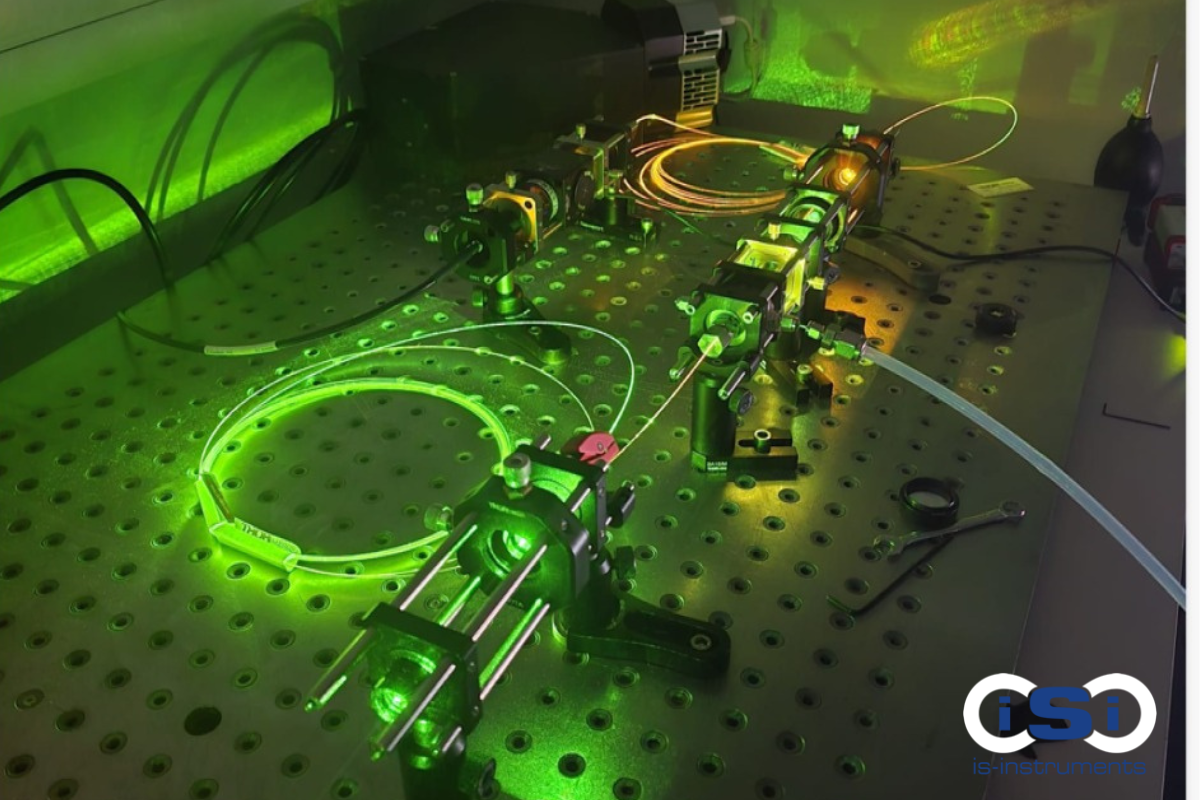
For scientists working with trace gases, the challenge is often not identifying what to measure. The challenge is reliably detecting it at ever-lower concentrations. As concentrations fall, Raman spectroscopy faces a fundamental limitation: the Raman effect is inherently weak. IS-Instruments’ Notus gas Raman technology addresses this by using hollow-core optical fibre to enhance the interaction between the laser and the gas sample. Recent testing has demonstrated detection of multiple gases at low-ppm concentrations, with results for methane and ethylene indicating potential detection limits extending into the hundreds of ppb. But there is another way to approach the problem. Instead of further increasing the interaction length, can the Raman process itself be changed to actively enhance the molecular response?
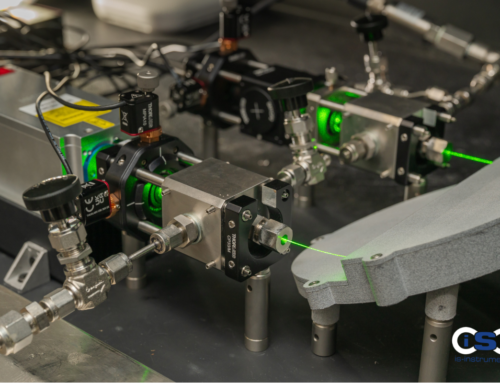
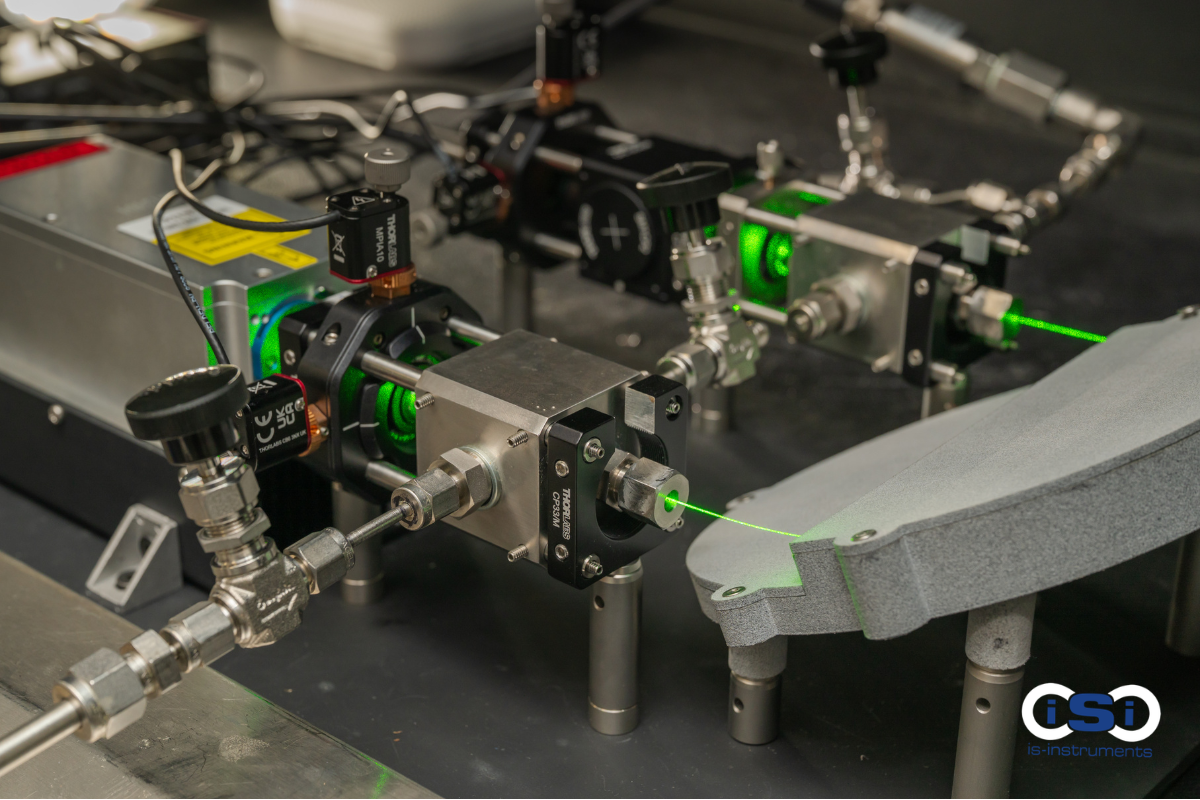
That is the question Dr Rhea Sam is investigating by developing a new Stimulated Raman System (SRS) at IS-Instruments.
The development target is ambitious: to investigate whether detection limits approaching 1 ppb can be achieved for selected gases. This remains a research target rather than a demonstrated detection limit. However, it provides a demanding benchmark for assessing how far Raman-based trace gas detection could be pushed.
Enhancing the Raman response
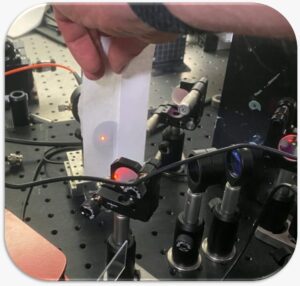 Unlike spontaneous Raman spectroscopy, stimulated Raman uses two laser beams to actively drive a specific molecular vibration. When the frequency difference between the pump and seed lasers matches a Raman transition of the target molecule, the interaction can greatly enhance the Raman response.
For scientists seeking to detect ever smaller quantities of a target gas, this presents an interesting possibility. Rather than relying solely on increasing the number of interactions between the laser and the sample, stimulated Raman directly addresses a fundamental limitation of conventional Raman measurements: the weakness of the signal itself. The potential gain in sensitivity, however, comes with a different set of technical challenges.
Selectivity creates an engineering challenge
Stimulated Raman depends on accurately matching the frequency difference between the pump and seed lasers to a selected Raman transition of the target gas. This makes selecting and controlling the laser sources central to system design.
For an application focused on a specific molecular species, the optical architecture can be designed around the relevant Raman transition. A system intended to analyse several gases presents a more complex problem. Tuneable lasers can offer some flexibility, but their tuning range is limited. Different target gases may therefore require different laser sources, wavelength switching, or a more sophisticated tuneable laser architecture. The question now moves away from whether a Raman signal can be enhanced. The question becomes how to integrate that enhancement into a practical analytical instrument.
What could greater sensitivity enable?
The significance of pushing Raman detection towards lower concentrations ultimately depends on the measurement challenge at hand.
One potential application is fusion and tritium handling. Here, scientists may need to measure very low concentrations of hydrogen and its isotopologues within complex gas mixtures. High-purity gas monitoring presents another challenge, where trace impurities must be detected against a much larger background gas. More broadly, SRS could offer particular value where target molecules are difficult to measure using conventional spectroscopic techniques. Improved sensitivity is only useful, however, if it can be combined with the selectivity, stability and repeatability required to obtain a meaningful measurement.
This distinction is important for the SRS development programme. The objective is not merely to demonstrate the lowest achievable concentration under ideal experimental conditions, but to investigate whether stimulated Raman can form the basis of a practical analytical approach to challenging trace-gas measurements. That means understanding both what spectroscopy can achieve and what is required to turn it into an instrument.
Why use stimulated Raman for trace-gas measurement?
Stimulated Raman is not intended simply to replace established techniques such as mass spectrometry or gas chromatography. These methods already offer extremely high sensitivity, and the best analytical technique depends on the application. Raman spectroscopy can offer different advantages. It can measure multiple gases non-destructively and could provide continuous, real-time measurements without first separating the components of a gas mixture. SRS adds the ability to target a particular Raman transition selectively, while potentially achieving much greater sensitivity than spontaneous Raman.
This could make SRS particularly interesting for applications that require sensitive and selective measurement of a target gas without introducing a more complex sample extraction or analysis system.
From experimental capability to analytical instrument
Rhea’s work therefore extends beyond maximising the stimulated Raman response. At this stage of development, one of the most significant challenges is achieving a sufficient signal-to-noise ratio (SNR) at very low concentrations.
The SRS signal can represent a tiny change on top of a much larger optical signal. Measuring that change reliably requires careful control of factors including optical coupling and stability, laser noise, wavelength stability and the detection electronics. Tunability presents a further challenge when considering a future multi-gas instrument. For the current experimental system, however, the immediate priority is achieving a stable and repeatable signal at low concentrations.
Different approaches to the trace-gas problem
The SRS project sits alongside IS-Instruments’ existing Raman gas analysis technology.
Our gas Raman systems use hollow-core optical fibre to extend the interaction between the excitation laser and the gas sample, an approach that is already demonstrating low-ppm detection across multiple gas species. Stimulated Raman tackles the sensitivity challenge differently, by actively enhancing a selected molecular response. Investigating different optical architectures enables the IS-Instruments team to identify where each approach offers advantages and how Raman spectroscopy can be adapted to increasingly demanding gas-analysis requirements.
The current development target of approaching 1 ppb provides a demanding benchmark against which the technology can be evaluated. However, reaching that figure is not the only measure of success. A stable, repeatable SRS system that shows a meaningful sensitivity improvement over spontaneous Raman would be an important result in itself. Beyond that, the team will investigate how the approach performs over time and within complex gas mixtures. Longer term, the ability to measure more than one gas without making the system prohibitively complex could help determine its potential as a practical analytical instrument
What are you trying to measure?
At this stage of development, one of the most interesting questions is not simply how low stimulated Raman can go, but which measurement problems could benefit from that capability.
Different target gases, concentration ranges and analytical requirements will place different demands on the optical system. Understanding those requirements is an important part of determining where stimulated Raman technology could ultimately deliver the greatest value.
If you are working with a challenging trace-gas measurement, particularly when existing approaches are limited by the concentrations you need to detect, talk to the IS-Instruments team. It’s the question that underpins everything we do. So, tell us – what are you trying to measure?