

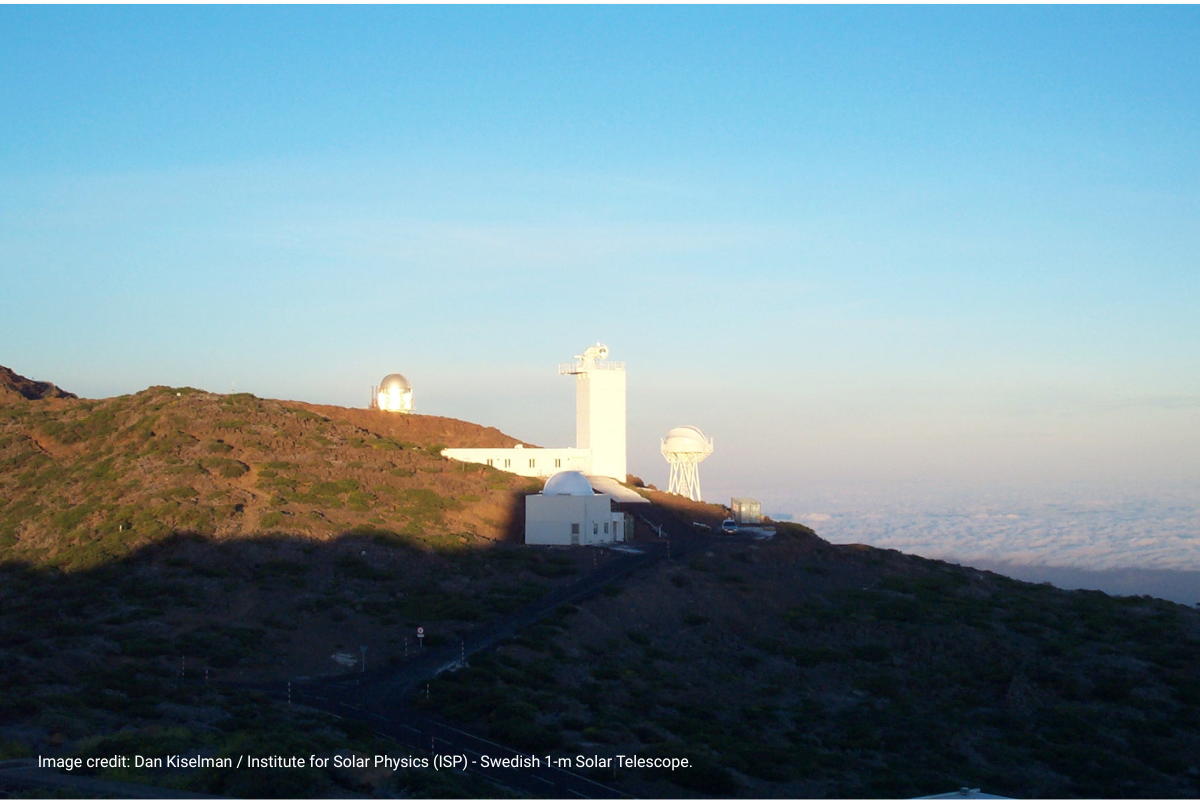
From CRISP to CHROMIS and CRISP2: supporting the evolution of high-resolution solar instrumentation.
At 2,400 metres above sea level on La Palma, the Swedish 1-m Solar Telescope (SST) enables astronomers to investigate the Sun’s complex behaviour. Commissioned in 2002, the telescope combines exceptional optical resolution with sophisticated scientific instrumentation. Researchers use it to study the structure, dynamics and magnetic fields of the solar atmosphere.
For almost two decades, IS-Instruments co-founders Dr Jonathan Storey and Dr Michael Foster have helped develop specialist optical filter systems for the telescope. Their work has involved demanding precision opto-mechanical engineering challenges. It spans several generations of solar instrumentation, from the original CRISP system through CHROMIS to more recent upgrades.
CRISP: the beginning of a long-running relationship
The relationship began around 2006. Jon and Mike worked with IC Optical Systems (ICOS), a specialist manufacturer of Fabry-Pérot etalons, to develop an optical filter system for solar observations. They also travelled to La Palma to install the equipment at the observatory.
Introduced in 2008, the CRisp Imaging SpectroPolarimeter (CRISP) enabled high-resolution imaging spectroscopy and polarimetry. It operated in the red region of the visible spectrum, covering wavelengths of approximately 510-860 nm. At its heart was a dual Fabry-Pérot tunable filter system. This allowed researchers to select narrow wavelength bands and investigate solar plasma and magnetic fields.
Achieving the required optical performance demanded exceptional precision in both manufacturing the etalons and the mechanical structures that supported and aligned them.
CHROMIS: extending observations into shorter wavelengths
In 2015–2016, Jon became involved in developing another specialist optical filter assembly for the telescope. The new instrument extended the SST’s observational capabilities into shorter wavelengths of approximately 380-500 nm. CHROMIS was designed particularly to observe the calcium II H and K spectral lines. These provide valuable information about conditions in the Sun’s chromosphere.
Working again with IC Optical Systems, which has a long association with the astronomy community, IS-Instruments developed bespoke housing for the optical assembly. ICOS supplied the Fabry-Pérot etalons, etalon controllers and camera and collimator assemblies. The housing had to provide precise thermal control, a hermetically sealed environment and mechanical stability, while fitting the limited footprint available on the instrumentation optical benches.
Precision engineering behind the optics
Fabry-Pérot etalons use interference between highly parallel reflective surfaces to transmit selected narrow wavelength bands. The large-aperture etalons supplied by ICOS achieve optical flatness measured in nanometres. Preserving that optical performance places exacting demands on the surrounding opto-mechanical assembly.
IS-Instruments designed a motorised alignment mechanism to support approximately 2 kg of glass and hold its position over extended periods, even without power. The assembly also required temperature control to within ±0.1°C. A hermetically sealed, dry-nitrogen environment protected sensitive optical coatings and helped maintain stable internal conditions.
Mechanical design, thermal behaviour, optical alignment and environmental protection therefore had to be considered as a single, integrated engineering challenge.
In 2025, Jon was approached about a further optical filter upgrade requiring larger-aperture components within the existing instrument footprint. Increasing the aperture affects the supporting structures, alignment mechanisms, and the optics themselves. The design therefore had to accommodate the larger components without sacrificing stability or performance. It also needed to withstand transport and installation at a remote observatory without further manufacturer intervention.
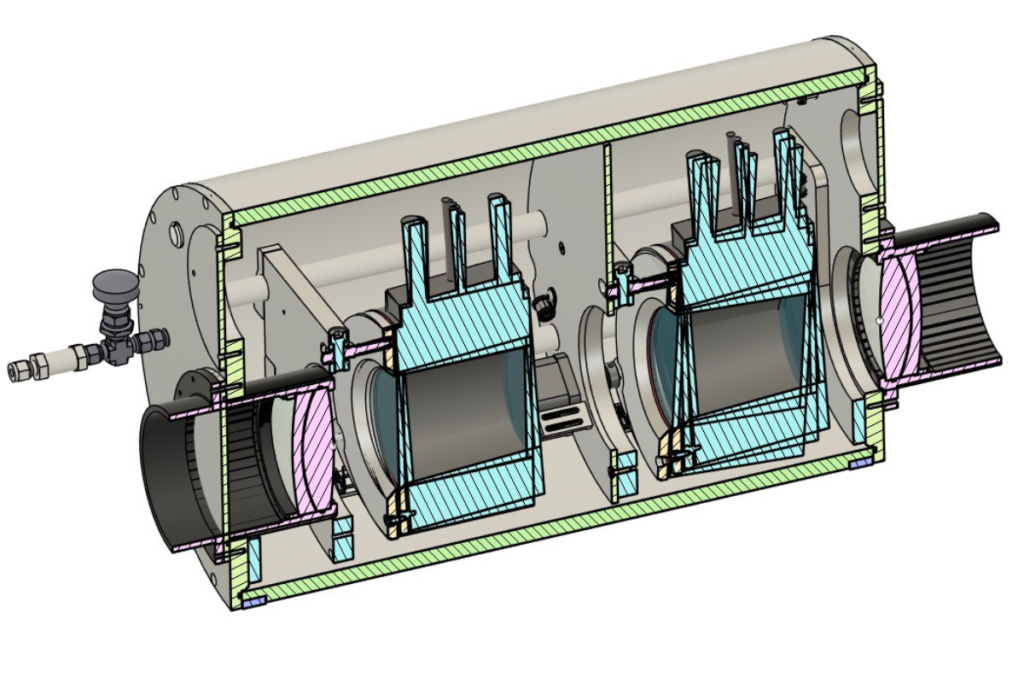
CAD cutaway showing the dual Fabry-Pérot etalon assembly and housing for the Swedish Solar Telescope. Image shared with the agreement of IC Optical Systems (ICOS).
Engineering recognised in published research
A peer-reviewed paper in Astronomy & Astrophysics (2026) documents the development of these optical systems.
Co-authored by Göran Scharmer, Dr Michael Foster, Dr Jonathan Storey and their collaborators, The making of robust and highly performing imaging spectropolarimeters for large solar telescopes examines CRISP, CHROMIS and CRISP2. The research explores their design, implementation and calibration. It also considers how compact optical layouts, carefully selected etalon characteristics and protected assemblies contribute to instrument stability and performance.
Supporting scientific discovery through precision engineering
The evolution of the Swedish Solar Telescope illustrates how scientific ambition drives engineering innovation. Researchers aim to observe larger areas of the Sun, investigate a wider range of wavelengths and measure magnetic fields with greater precision. Each advance places new demands on the instruments that support their work.
For IS-Instruments, these projects demonstrate the ability to solve complex opto-mechanical challenges within tight physical and environmental constraints. That expertise extends beyond solar astronomy to spectroscopy, photonics, advanced imaging and bespoke scientific instrumentation.
The projects also demonstrate the value of long-term technical relationships. Over nearly two decades, Jon and Mike have applied established engineering principles to successive generations of increasingly sophisticated instruments.
From the original CRISP system to the latest advances in solar observation, the objective remains unchanged: to develop precision engineering solutions that help scientists see and measure what would otherwise remain beyond reach.
Have a challenging optical measurement or instrumentation requirement?
Contact us to discuss how our precision opto-mechanical engineering expertise could help.
